
How the Right Hardware Transforms Your Digital Menu Board Investment
A digital menu board is only as effective as the hardware behind it. Restaurants, quick-service chains, and food service operators increasingly rely on commercial-grade displays and dedicated media players to deliver content that looks sharp, runs reliably, and drives revenue. Yet many businesses underestimate the gap between consumer electronics and purpose-built signage hardware. Understanding that gap is the first step toward building a system that performs from day one. OSM Solutions works with operators every day to pair the right screens and players with Menuboard Manager, creating end-to-end solutions that simplify operations and elevate the guest experience.
Commercial Displays Versus Consumer Screens: A Critical Distinction
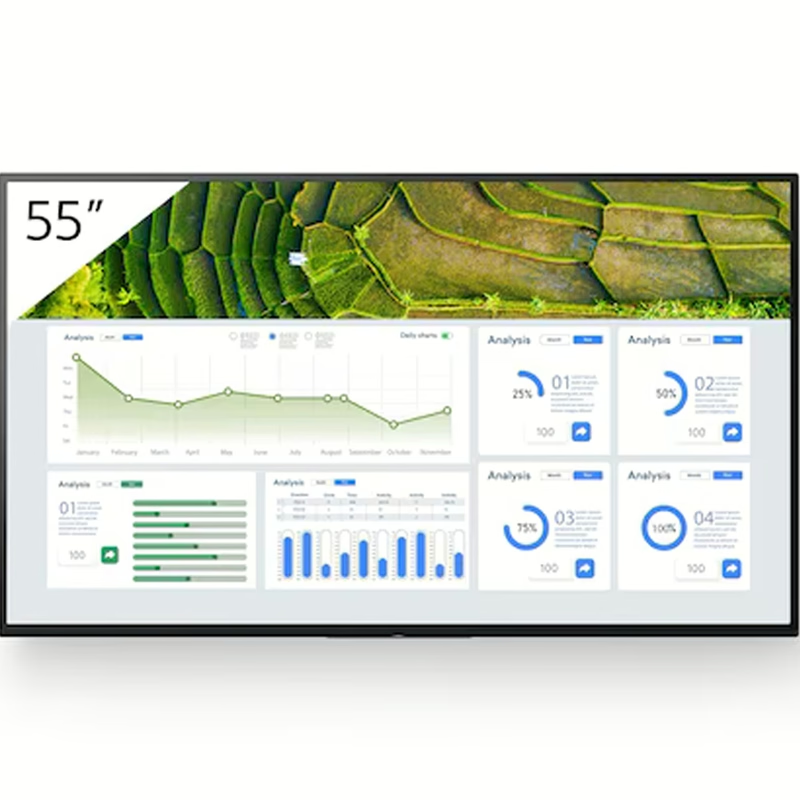
Consumer televisions were engineered for a living room — a few hours of use per day in a controlled lighting environment. Place one behind a restaurant counter or in a drive-thru lane and you will quickly encounter problems: overheating, diminished brightness, premature panel failure, and voided warranties. Commercial displays from manufacturers like Samsung and Sony are built specifically for these conditions. They offer higher sustained brightness levels, wider viewing angles, and thermal management systems designed for around-the-clock operation. The result is menu content that stays vibrant and legible under fluorescent lighting, direct sunlight, or the harsh glare of a kitchen pass-through window. Over a three-to-five-year lifecycle, commercial panels consistently deliver a lower total cost of ownership because they avoid the replacement cycles that plague consumer alternatives.
Why Dedicated Media Players Eliminate Performance Bottlenecks
Even the best display will disappoint if it relies on an underpowered or unreliable playback device. Dedicated media players — such as BrightSign hardware or the Google TV Streamer 4K — are optimized for signage workloads. They boot directly into content, handle 4K video without frame drops, and maintain stable network connections for remote updates. This matters in a restaurant environment where a frozen screen or buffering animation at the point of sale can stall the ordering process and erode customer confidence. When connected to Menuboard Manager, these players receive content pushes seamlessly, allowing operators to change pricing, rotate daypart menus, or launch promotions across every location from a single dashboard.
Matching Hardware to Your Operational Goals
Selecting displays and players is not a one-size-fits-all decision. A single-location café with one screen above the register has different requirements than a multi-unit QSR chain managing hundreds of indoor and drive-thru boards. Factors like screen size, orientation, resolution, ambient light exposure, network infrastructure, and POS integration needs all influence the ideal configuration. OSM Solutions helps operators evaluate these variables so they invest in hardware that scales with their business rather than limiting it. Recent case studies and deployment insights are available on the OSM Solutions blog, offering practical guidance for operators at every stage of adoption.
Build a Reliable Digital Menu Board System Today
The combination of commercial-grade displays, purpose-built media players, and a powerful cloud CMS like Menuboard Manager creates a digital menu board ecosystem that is visually compelling, operationally efficient, and built to last. Whether you are upgrading an existing setup or deploying screens for the first time, OSM Solutions provides the hardware expertise and software platform to get it right. Ready to discuss your project? Contact us to schedule a consultation and find the configuration that fits your goals.
